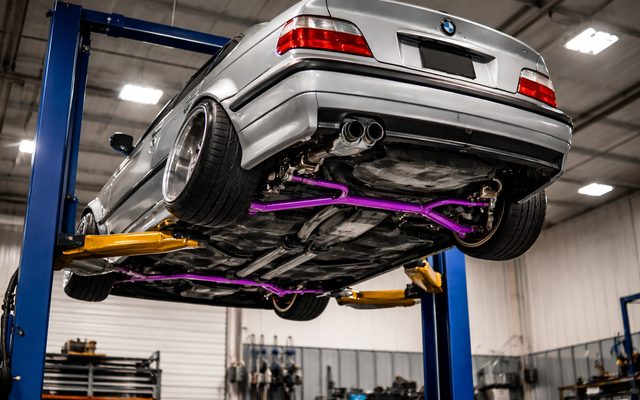
In the intensely competitive realm of modern pro-level drifting, podium finishes is no longer purely a result of brute engine power or driver bravado. Instead, it is now a intricate discipline that requires a scrupulous fusion of choosing a inherently capable vehicle platform, equipping it with the highest-quality performance components, and, most importantly, understanding its real-time characteristics on the track through sophisticated suspension tuning applications. This comprehensive handbook functions as your roadmap from the very first concept of a competition vehicle through to the last telemetry-optimized tweaks that elevate a powerful car into a repeatable winner. We will delve deep into the precise engineering of vehicle alignment optimization, showing how a advanced drift tuning app like precise measurement hardware removes approximation and provides unmatched clarity into your vehicle's actual behavior.
The bedrock of any exceptional drift car is, undoubtedly, the base vehicle itself. A select group of cars have achieved renowned status within the worldwide oversteer culture due to their built-in handling characteristics, robust build quality, and the immense ecosystem of specialist parts available. Choosing the optimal starting point is the first and most important decision a driver will make. To illustrate, the BMW's E36 3 Series is universally acknowledged as perhaps the the greatest overall drift platforms of history. Its near-perfect 50/50 weight distribution, alongside a RWD layout and extremely reliable inline-six motors, creates a car that is both accessible for novices and incredibly capable in the control of a professional pilot. The successor of this philosophy, the BMW E46 platform, builds upon these attributes with a increasingly sophisticated chassis, wider wheel track for improved confidence, and yet increased steering angle directly from the factory. Another formidable contender in the pro arena is the Corvette C6.
This American performance car offers a unique combination of advantages to the sideways world, including a low-mass aluminium structure, a backwards-positioned drivetrain component that helps create an ideal weight distribution, and the immense torque of a large-displacement GM LS engine. This fusion renders it an absolute force on track, designed of initiating and holding long angles with apparently easy deployment of acceleration. For builders seeking outstanding performance per dollar, the Nissan Z33 excels as a top-tier choice. It comes from the factory with a stiff chassis, a decent original locking differential, and the free-revving VQ35DE motor that provides ample performance for learning and moving up in the activity. Its newer version, the Nissan 370Z, brings additional advancements in structural rigidity, handling precision, and overall powerplant output, solidifying its status as a common choice among professional drivers. Additional historic platforms that deserve attention are the agile rotary-powered Mazda FC, the most popular Nissan S13, the torque-rich SN95 generation Mustang, the electronic-equipped BMW E90, and the small yet unbelievably playful and instructive Mazda MX-5. All of these platforms gives a distinct set of characteristics, difficulties, and possibilities, but they all have in common the basic elements essential to serve as a capable sliding vehicle.
However, choosing the optimal car is merely the beginning. To access the complete performance of every of these vehicles, significant modifications to the steering and suspension systems are absolutely mandatory. This is where the domain of precision tuning hardware comes into critical view. The single most transformative upgrade for a serious drift machine is the installation of a drift-spec drift angle kit. These sophisticated assemblies, such as those engineered by industry leaders like SLR Speed, are created to dramatically expand the vehicle's available lock-to-lock rotation. A OEM road car is extremely limited in how far its tires can pivot, a safety trade-off for public road operation. In oversteer driving, however, aggressive steering input is constantly needed to catch and hold a slide. An modification kit substitutes the stock hubs, rod ends, and potentially A-arms with pieces that enable the wheels to achieve degrees of turn over 70 or even 80 degs, compared to a normal stock limit of around 40 to 50 degrees.
This immensely increased steering angle offers the pilot with dramatically more control during a drift, making it considerably easier to begin a drift, sustain it through a extended turn, and change seamlessly from one side to another. The difference in handling is truly revolutionary. Paired with a appropriately specified steering kit is the equally vital enhancement to the vehicle's spring and damper setup. Off-the-shelf or including high-end sport dampers are simply not engineered for the unique and brutal demands of drifting. A dedicated set of suspension units is of utmost importance. These specialized suspension components feature unique piston tuning and spring strength that are tuned for the violent load shifting that is inherent of drifting. When a driver initiates a drift, the vehicle's inertia is transferred rapidly to the outside of the bend. Optimal drift-spec coilovers control this movement in a consistent way, enabling the chassis to find its balance promptly and offering the pilot precise response through the controls and driver's seat. They additionally provide exact tuning of stance, damping firmness, and cross-weight, which are all key elements of dialing in the vehicle's dynamics to a specific track or driving approach. In combination, a high-quality steering angle kit and a properly chosen pair of drift-spec suspension units constitute the core mechanical base upon which all future optimization is built.
Once the core parts is installed, the following vital stage in the development is the meticulous tuning of the chassis's wheel angles. This is the world of car suspension tuning, a process that can appear intimidating to the newcomer but is, in practice, the key to converting a collection of high-performance parts into a unified and consistent whole. The most discussed element of alignment for drifting is undoubtedly camber. Wheel camber is the tilt of the tire in relation to the upright line when looked at from the forward of the chassis. When the top of the wheel is tilted inward, this is known as negative camber. In drifting, negative camber on the front axle tires is generally applied and is considered essential. The logic is fundamentally tied to tire contact.
When a car is turning at extreme angles, the chassis rolls toward the outer of the corner. This body roll makes the outer front wheel to reduce its optimal footprint with the track surface. By introducing negative camber, the wheel is pre-leaned to counteract this lean. As the car tilts into the turn, the outside front tire flattens out with the track, maximizing its traction at the critical point when it is absolutely essential for steering authority. Typically, front camber settings for a serious drift car vary from approximately -3 degrees to as much as -5 degrees or even greater, contingent on the parameters of the car configuration, compound type, and driver feel. The rear axle tires also utilize inward tilt, but the angles are generally more modest and subtler than the front. Too much camber at the rear can make the car extremely loose and hard to predict on acceleration use, as it shrinks the effective tire footprint of the driving tires during forward acceleration. Thus, rear axle adjustments are often in the ballpark of -1 degree to -3 degrees, achieving a careful equilibrium between providing enough lateral traction to help in entering and holding the drift while simultaneously maintaining good grip car suspension tuning for exiting the bend. camber angle is only one component of the larger alignment puzzle, which additionally encompasses toe, caster angle, and bump steer adjustment.
Toe angle describes the direction of the tires as seen from the top. Toe-in means the leading edges of the tires are closer together than the rear edges, while outward toe means the reverse. For sliding, a slight amount of front axle negative toe is frequently used to sharpen the initial steering reaction, making the car feel more agile and ready to initiate a slide. Rear axle toe is usually set to zero or a incredibly minute amount of inward toe to encourage stability under throttle. Caster is the forward or aft angle of the kingpin axis when viewed from the lateral of the vehicle. More positive caster increases steering feel and stability stability, and it also adds to negative camber gain during turning, which is extremely useful. Adjusting these parameters is a detailed interplay where a adjustment to one parameter can and often will influence the remaining parameters. The old-school process for tuning a vehicle's suspension geometry for competition has historically been a time-consuming endeavor of trial and error. A driver or team would apply a adjustment based on intuition, test the vehicle on track, depend on the driver's individual perception and impressions, and then apply an additional change. This cycle would iterate time after time until the chassis felt "good" or the available practice session ran out. This methodology is not only exceptionally slow in terms of time and resources, but it is furthermore inherently imprecise.
Driver perception is a famously inconsistent measurement tool, colored by many elements such as fatigue, varying track grip levels, weather, and merely the focus of the driver on that specific run. What feels "oversteery" on one pass might feel "pushing" on the next run, leading to conflicting data and frustrating changes. This traditional challenge in car suspension tuning is precisely where contemporary telemetry systems has stepped in to transform the landscape.
The development and integration of advanced vehicle dynamics tools has introduced a completely new age for building and optimizing competitive sliding vehicles. This new generation of systems, represented by cutting-edge systems like data acquisition tools, work by directly measuring the real-time physical performance of the vehicle as it is piloted on the circuit. Unlike depending on subjective feedback, these systems acquire quantifiable data on essential variables such as shock absorber movement, individual tire rotation, lateral and longitudinal g-forces, lock position, and driver input position. This collected telemetry is then processed by sophisticated software that can plot and decode the metrics in a actionable manner. For the first time ever, tuners and crews can observe exactly what the car is exhibiting at every millisecond of a drift. This ability revolutionizes the whole suspension tuning process. Imagine the aforementioned challenge of dialing in the front negative camber for a given chassis. Rather than making a modification from -3 degrees to -3.5 degrees and then running several laps to try and "perceive" a improvement, a suspension tuning tool can deliver immediate and clear data. The tool can show visually how the tire's loading is behaving during the most important phases of a drift: initiation, mid-corner, and transition. It can show if the present angle is allowing the loaded tire to keep ideal contact or if the compound is over-stressed on its external edge.
The tool can then suggest data-driven recommendations for adjustment. Perhaps the data indicates that the outside front tire is still stressing its sidewall at -3.5 degrees of camber, indicating that a move towards angle, say -4 degrees, might be beneficial. On the other hand, the information might reveal that the tread is failing to reaching optimal operating temp or that the inner shoulder is degrading too quickly, which could indicate that there is excessive inward lean and a small lessening back to -3.2 degrees would be more ideal. This standard of accuracy and actionable insight was completely impossible in the time of solely manual tuning.
The benefit of using a advanced drift telemetry system goes well beyond merely optimizing camber angles. It becomes an essential coilover setup tips that is specific to your specific vehicle. When setting the damping values on your suspension, instead of using imprecise advice or replicating another driver's settings, you can employ the data to analyze how the chassis is performing in relation to your tweaks. The application can graph the suspension travel trace over a lap, showing if the shocks are handling the weight transfer effectively or if they are permitting the chassis to oscillate too much after a flick. It can assist in identifying problems like bottoming out or excessive extension, permitting you to introduce educated choices to spring preload, rebound/compression values, or ride height. This approach translates similarly to the complex task of corner balancing. In addition to camber, the software can provide data into how changes to toe and caster angle are impacting the chassis's stability during specific maneuvers suspension engineering of a lap. For instance, it can assist you to find the optimal amount of front toe out for your particular angle kit setup and piloting technique by showing the speed of initial reaction and the predictability of the vehicle at lock steering angle. This makes the tool an incredibly powerful vehicle dynamics manual that is dynamically calibrated by the live dynamics of your personal vehicle on the track. It elevates the whole project from a mysterious craft into a methodical optimization exercise.
Furthermore, the application of a tool like GripDial is not at all limited to expert teams with large vehicle dynamics tool funding. For the club-level enthusiast, it functions as an powerful equalizer. It in essence offers the builder with the knowledge of a expert suspension specialist without needing the corresponding expense. It accelerates the learning curve by providing definitive answers to problems that would traditionally take years of trial and error to answer. A tuner can learn how their specific vehicle responds to various adjustments, developing a more profound comprehension of suspension theory in the journey. It additionally makes accessible professional performance tuning principles, allowing every enthusiast with the drive to perfect their vehicle to accomplish it in a systematic and successful way. This is particularly significant in a sport like sliding, where engineering expertise has traditionally been a closely guarded asset among professional drivers. In the modern era, that capability can be in the hands of any dedicated driver.
In summary, the process to engineering and dialing in the ultimate championship-contending drift machine is a comprehensive project that seamlessly combines proven mechanical wisdom with revolutionary data tools. It commences with the strategic choice of a proven chassis, then built upon the installation of non-negotiable competition hardware like maximum-angle steering angle kits and expertly valved performance coilovers. The build then progresses into the precision realm of chassis dynamics adjustment, where parameters like camber angle, toe setting, and caster angle are precisely set to complement the car's new geometry and the driver's individual technique. Ultimately, and what really separates the contemporary process from the traditional methods, is the adoption of a powerful suspension tuning application. This platform eliminates the approximation and waste of solely seat-of-the-pants adjustment by delivering empirical, live information on how the car is really performing. It functions as an incredible diagnostic aid, a definitive alignment optimization handbook, and a comprehensive chassis development system. Together, this integrated methodology guarantees that every element of the drift car—from the pick of the car to the final click on the coilover—is refined for ultimate performance on the track. It embodies the total progression of the art of oversteer driving, merging raw car control with data-informed suspension engineering to forge the perfect competitive cars possible.